

Montana State University
Montana State University >College of EHHD >Science Math Resource Center

College of Education, Health & Human Development

Montana State University
P.O. Box 172940
250 Reid Hall
Bozeman, MT 59717-2940

Tel: (406) 994-4133
Fax: (406) 994-1854

Dean:
Dr. Lynda Ransdell
ehhddean@montana.edu

Director:
Dr. Elisabeth Swanson
eswanson@montana.edu

Interim Director:
Dr. Irene Grimberg
grimberg@montana.edu

Admin. Associate:
Annie Mollock
annie.mollock@monatana.edu

Admin. Assistant:
Jesse Hunter
Jesse.Hunter1@montana.edu


Science Math Resource Center

College Department
  • Whats Up?
  • Overview
  • Professional Development
  • Science Olympiad
  • About Us

What's Up?

Family Fun, Food, and Learning Night: Better than Christmas!!

Monday April 22, 2013

There is vast research supporting the idea that reading and parental engagement in school activities are critical factors to facilitate students' learning in ALL content areas. Moreover, reading or being read to during the summer months is very important to enhance or retain students' literacy level. Any reading material, and reading in any way -picture or text based books, and doing hands-on activities- is beneficial.  The important thing is that students pick their books!

The Science Math Resource Center in partnership with Hopa Mountain organized a powerful and transformative educator training to engage school students and their family in a Family Fun and Learning Night program.  Dr. Bonnie Sachatello-Sawyer, Hopa Mountain director, led the training focusing on: how to implement this family learning program in a school, storytelling and reading aloud-techniques, exploratory science-activities, and give-away books to children. Bonnie modeled a rock sorting activity inspired by the book "If You Find a Rock" by Peggy Christian and Barbara Hirsh Lember. Then teachers examined different ways to use this activity in their classroom, not only to address science content but also to reinforce reading comprehension and explore mathematical concepts. 

A picture astronomy book "There's No Place Like Space" by Tish Rabe and Aristides Ruiz was introduced along with night observations and recording of moon phases.  Ideas to extend this hands on-reading aloud activities to parent conference settings or school family nights, such as Astronomy Night and Science Night, were also discussed. The teachers received lesson plan packages for the rock and astronomy programs with descriptions of activities for students, parents and students, tips for parents for reading aloud and literacy activities at home, a book list.  The training concluded with teachers picking books for their classrooms and their students including: rock books; books about the moon, night sky, and Sun; books about Spring, about dogs, and many more!!

If you want to receive the activity packages and /or the books please visit the Hopa Mountain website, or e-mail Bonnie: bsawyer@hopamountain.org. If you need assistant and ideas to implement these activities in your classroom, or during parent conferences or family nights please contact the Big Sky Science Partnership teachers: Tanya Anderson (Hardin Intermediate), Devon Flamm (Hardin Intermediate), Reba Strom (Hardin Elementary), Dorcella Plain Bull (Pretty Eagle), and Michelle Jefferson (Pretty Eagle).


Big Sky Science Partnership (BSSP) Teachers in the News!

Tuesday April 9, 2013

Little Big Horn News, a Hardin newspaper, made an article about BSSP teachers trip to the 2013 NSTA Conference in San Antonio, Texas. To read more please go to the story link.


Overview

Picnic TableThe Science Math Resource Center (SMRC) is devoted to the advancement of science and mathematics teaching and learning. We provide professional development for a new generation of K-12 educators of tribal, rural, and urban communities; conduct educational research; and coordinate the statewide annual Science Olympiad that is held at Montana State University in Bozeman.


Our professional development programs are delivered face-to-face and online to facilitate the formation of teachers' learning communities and to provide access to teachers in remote areas.  Our programs focus on science and math content and research-based practices with a strong emphasis on the cultural context of the school community. The SMRC is a proud partner of the Montana
Science Teachers Association
(MSTA), working together to
promote the advancement of science education to all students in
Montana through providing support to preK-12 science teachers. The faculty and university students associated with the SMRC conduct educational research for online learning and teachers' education. At the SMRC we facilitate professional experiences for graduate students interested in STEM teaching and learning in tribal and rural K-12 schools.  The SMRC supports the Montana Science Olympiad Corner, a year-round site dedicated to Science Olympiad coaches and students with resources, tips, and news.

Professional Development


A Predictive Model to Increase Adoption of IPM of Mite-Virus Disease Complex
in Wheat

This regional project -involving communities from Texas, Montana, Nebraska,
Oklahoma, Colorado, and Kansas- focuses on the development and dissemination of
an accurate forecasting model of wheat viruses in order to improve the sustainability
of wheat production. SMRC in collaboration with researchers of Land Resources
and Environmental Science and Plant Science and Plant Pathology departments at
Montana State University and Department of Entomology of the University of Nebraska-
Lincoln, use science core ideas of the model to develop educational curriculum,
organize students field experiences, and deliver teacher professional development.
The curriculum is organized in online modules including science content background,
simulations, animations, games, video clips of mite's microscope views, and scientist
interviews. In turn, the modules are deployed to develop student (graduate,
undergraduate, and G-12 students) and science teachers learning opportunities based
on the management of this wheat-mite-virus complex to demonstrate the principles of
biology, ecology, and engineering. Teacher on-site professional development and G4-20
students field experiences are conducted in Montana and Nebraska.


Integrating Environmental Education Throughout the Curriculum (IEETC)

IEETC is a professional development program focused on increasing G2-8 teachers’ abilities to integrate local environmental and indigenous topics into science content teaching. The program is delivered in two tribal communities, Salish Kootenai and Crow, and is centered on STEM topics. IEETC combines tribal members' presentations and panel discussions of local environmental issues, on-site workshops about inquiry-based activities, and online discussions allowing teachers to share teaching approaches and lesson ideas. The training is provided in collaboration with faculty of Montana State University, Little Big Horn College, and Salish Kootenai College. Teachers that participate in IEETC learn about the environmental issues facing their students’ communities from scientific and tribal-historical perspectives. IEETC impacts about 20 teachers and 400 students. IEETC is funded by the Montana Office of the Commissioner of Higher Education, Educational Talent Search program.


Big Sky Science Partnership (BSSP)

BSSP focuses on the design and implementation of science teachers' professional development in American Indian reservations in Montana. BSSP is comprised of partners from five tribal communities, three institutions of higher education, and forty-five K-8 schools on and around the Flathead, Northern Cheyenne and Crow Reservations. The goals of this multi-year project are: 1) to increase teachers' science content knowledge, 2) to improve science instructional practices and culturally congruent teaching, 3) to improve students' science achievement, and 4) to form a cadre of teacher leaders that will assist other teachers in their own community. BSSP professional development is implemented in three content areas: Earth Science; Astronomy and Weather and Climate; and Physics. All instruction in these areas are framed by culturally responsive teaching approaches. The professional development is delivered face-to-face and online, such that teachers attend monthly face-to-face workshops and participate in online semester-long courses that deepen the face-to-face topics and facilitate the formation of a teacher's learning community; attend a two-week summer institute focused on the integration of science, pedagogy, and culture; and participate in a summer cultural camp experiencing tribal American Indian culture. Being in its last year, BSSP impacted about 100 teachers plus 15 American Indian pre-service teachers, and 2000 students in grades K-8. Approximately 60% of these students are American Indians living on Montana's American Indian reservations. BSSP is funded by the Mathematics and Science Partnership program of the National Science Foundation. More infomation


Science Inquiry Learning in the Classroom (SILC)

SILC was a professional development program for K-6 teachers of urban and rural school districts in Montana, aiming to increase teachers' science content knowledge, to promote inquiry-based teaching, and to facilitate classroom implementation of the resources identified by Montana Office of Public Instruction Indian Education For All (IEFA) program. In partnership with the Montana Learning Center, Montana State University, Montana Regional Education Services Area IV, and Helena and Bozeman school districts, SILC delivered a blended model professional development including: face-to-face monthly inquiry academies, teachers' webinars, online coursework, scientists classroom virtual visits, and instructional coaching. The inquiry academies, webinars, and online coursework addressed the Montana Standards for Life Science and Physical Science, and inquiry-based pedagogical practices. Instructional coaching involved working on an individual basis with each teacher at least once a month encouraging the use of age-appropriate content and inquiry. Classroom virtual visits facilitated scientist and student dialogs centered on the concept of energy. SILC impacted 60 teachers and approximately 1300 K-6 students. SILC was funded by the Mathematics and Science Partnership program of the Montana Office of Public Instruction.


E-Mentoring for Students Success (eMSS)

eMSS is an online mentoring program for science and mathematics teachers. eMSS started as a partnership comprised of NSTA, the Science Math Resource Center and the Burns Telecommunications Center at Montana State University, the NSF Center for Learning and Teaching in the West, the New Teacher Center at the University of California, Santa Cruz, and a number of school districts in Montana and California. The primary goal of eMSS is to develop a national online, content-rich, mentoring system to improve the skills of, and provide support for novice middle and high school science teachers.  eMSS  develops an online network of mentor teachers, science and math educators, and scientists and mathematicians who support beginning teachers in their efforts to provide high quality instruction to their students. Joining California and Montana, eMSS gradually incorporated other states reaching up to 16 states in the nation. eMSS was funded by National Science Foundation and currently is self-supported by user districts and administrated by the New Teacher Center.


Center for Learning and Teaching in the West (CLTW)

The CLTW is a consortium of five universities: Portland State University, Montana State University, the University of Montana, Colorado State University and the University of Northern Colorado, in partnership with Ft. Belknap College (MT), other community and tribal colleges, the Portland Public Schools, and 68 rural and reservation schools in Montana and Colorado. This partnership arose from shared interests on improving teacher preparation; delivering high quality professional development; providing advanced degree programs in education; developing science and mathematics education research; exploring innovative delivery systems; and documenting experiences in systemic collaboration. Sixty-two graduate students (51 doctoral and 11 master students) completed their studies in the frame of CLTW. Research work supported by CLTW includes studies on: K-12 student achievement differences; cultural issues affecting student performance and participation; professional development to promote teacher knowledge, and community and capacity building; distance education; and access to and success in higher education. CLTW was funded by the National Science Foundation.


Systemic Teacher Education Preparation (STEP)

STEP is a project for the improvement of STEM education of pre-service teachers in the state of Montana. Based at MSU, the STEP project has formed a collaborative partnership between the university system campuses, Montana's seven tribal colleges, and numerous K-12 field sites throughout the state. STEP redesigned mathematics, science, and methods courses for pre-service teachers, using model field sites as "living laboratories" for research on effective pre-service training. As a result of these initiatives, the number of minority students preparing to teach in STEM fields significantly increased, and a distance-based mentoring system for new teachers in a rural state was piloted. STEP was funded by the National Science Foundation Division of Undergraduate Education program.

Science Olympiad

Corvallis Students

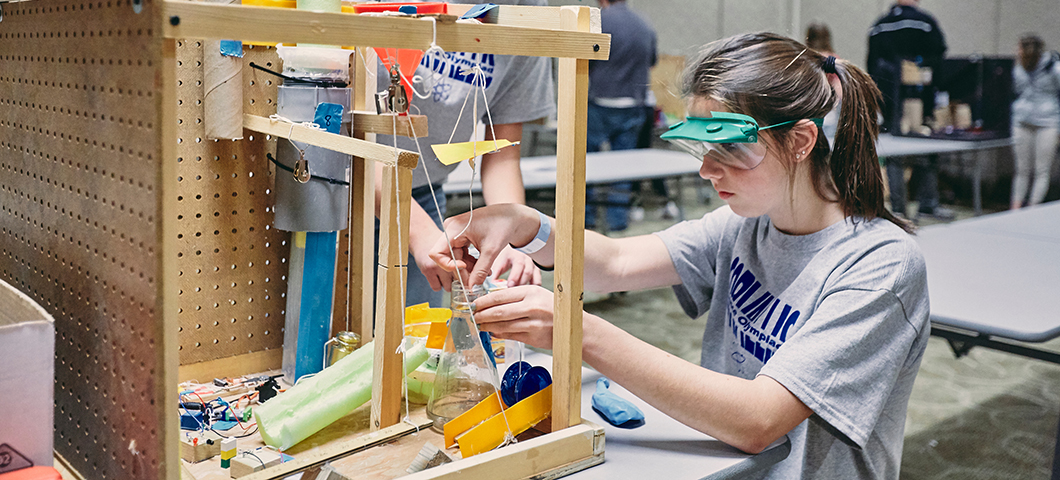
The Montana Science Olympiad is devoted to improving the quality of science education, increasing student interest in science and providing recognition for outstanding achievement in science education by both students and teachers. The Science Math Resource Center at Montana State University in Bozeman hosts the annual Montana Science Olympiad in conjunction with the National Science Olympiad.

The Science Olympiad goals are accomplished through the dedication of Montana science teachers and parents who organize classroom activities, research, and after school training clubs. The main focus of the competition is to elevate science education and learning to a level of enthusiasm and support that is normally reserved only for varsity sports programs.

The Science Olympiad tournaments are rigorous academic inter-scholastic competitions that consist of a series of individual and team events. In grades 6-12, a Science Olympiad team functions much like a football or soccer team, requiring preparation, commitment, coaching and practice throughout the year. Other competitions follow the format of popular board games and TV shows. These challenging and motivational events are well balanced between various disciplines: biology, earth science, chemistry, physics, computer science and technology. There is also a balance between events requiring knowledge of science facts, concepts, processes, skills and science applications.

For more information visit the National Science Olympiad site or the Montana State Science Olympiad site.

About Us


Elisabeth Swanson
Director

Contact Information:
401 Linfield Hall
Montana State University
Bozeman, MT 59715
eswanson@montana.edu
406-994-5952

Dr. Elisabeth Swanson is the director of the Science Math Resource Center (SMRC), a position she has held since 1996. She focuses on preparing doctoral students in the sciences, mathematics and education as they conduct research and outreach to improve the science and mathematics learning of high need student populations, as well as conducting research to better understand and narrow achievement and participation gaps in science and mathematics. Elisabeth’s current work focuses on the design of professional learning networks for rural, reservation teachers of science and mathematics and includes collaborative research projects with tribal colleges. Read more


Irene Grimberg
Interim Director

Contact Information:
401B Linfield Hall
Montana State University
Bozeman, MT 59715
grimberg@montana.edu
406-994-7612

Irene Grimberg is an associate research professor at the Science Math Resource Center (SMRC) and an affiliate research scientist at Montana State University (MSU) Department of Physic. Currently she serves as the interim director of SMRC. Irene has experience in designing and delivering professional development for science teacers in rural areas and American Indian reservations in Montana. Her research interests are in science teaching and learning, specifically argumentation and science discourse in the classroom and online settings, technology education, and curturally responsive teaching. Irene serves on several national education boards. Read more


Annie Mollock
Administrative Associate

Contact Information:
401 Linfield Hall
Montana State University
Bozeman, MT 59715
annie.mollock@montana.edu
406-994-7476

Annie Mollock is the administrative associate for the Science Math Resource Center. She provides a variety of administrative support, customer service, and fiscal management duties in support of the Center including managing the day-to-day operations; assisting in developing policies and procedures for the Center; tracking information and interpreting data; resolving bookkeeping transactions; monitoring and reconciling varied funding; preparing forms and documents; and helping with the coordination of the annual Science Olympiad.


Jesse Hunter
Administrative Assistant

Contact Information:
401 Linfield Hall
Montana State University
Bozeman, MT 59715
jesse.hunter1@montana.edu
406-994-6768

Currently an undergraduate in the MSU College of Engineering, Jesse is the office’s student aide. He assisted in hosting the last three Montana State Science Olympiads. In addition he provides the office with data entry services and web maintenance, including this webpage and the Montana State Science Olympiad website.